
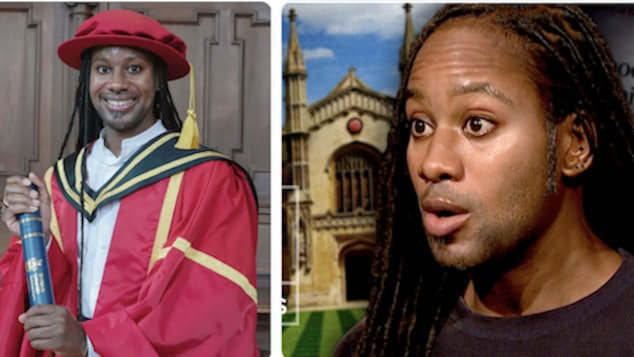

Jason Arday Cambridge black professor kills self just days after prestigious UK school opens investigation into allegations of plagiarism as childhood stories of learning difficulties raises questions how exactly the token academic was able to ascend so high?
Was he a fraud or was one black scholar’s death the tragic price of diversity and wokism?
A former Cambridge University professor in the UK was found dead just days after quitting his job at the prestigious school over allegations that he plagiarized and lied about past jobs.
Jason Arday, 41 — the youngest ever black professor at the lauded university— was found ‘unresponsive’ in his south London home on Friday and later pronounced dead at the scene according to local media.

‘Sadly, a 41-year-old man was pronounced dead at the scene. His next-of-kin have been informed and are being supported by officers,’ a spokesman for the Metropolitan Police told the UK Telegraph.
‘At this time his death is being treated as unexpected, but is not believed to be suspicious. The case is being investigated by officers from the Met’s Central South Command Unit. A file will be prepared for the coroner.’
University of Cambridge Vice-Chancellor Professor Deborah Prentice expressed sympathy over his death Friday.
‘We are desperately saddened to hear this tragic news. Our heartfelt sympathies go to Jason Arday’s family and friends at this incredibly difficult time,’ Prentice said in a statement.
The poster boy for diversity but at what price?
The sociology professor, who became a poster boy for diversity, and who had previously admitted to being mute and illiterate as a young boy resigned from the job on Aug. 5 as the school launched an investigation into accusations that he plagiarized parts of his Ph.D dissertation and lied about positions he held at other schools.
Ardy cited an ‘unrelenting level of public scrutiny’ as his reason for resigning.
‘[It’s] simply the decision of someone who has reached the limits of what any person should reasonably be expected to endure,’ he said at the time.
Arday had faced allegations that he lifted more than 100 passages in his dissertation from another academic, Brunel University student Paula Zwozdiak-Myers.
Most extreme case of academic plagiarism?
Nathan Cofnas, a postdoctoral researcher at Ghent University in Belgium, published a Substack article last month detailing several examples in which Arday’s doctoral dissertation appeared to be plagiarized.
An analysis later showed more than 100 passages in his thesis reportedly appeared to be similar to or lifted from the thesis of Zwozdiak-Myers.
But there was more to come for the beleagured academic.
Arday then came under fire for allegedly falsely claiming to have held three positions at academic institutions — Ohio State University, University of Glasgow and Durham University — on his official biography page for Cambridge University.
Before launching an investigation, the school initially stood behind the professor, claiming he was a victim of a ‘vile campaign to undermine his credibility.’
Arday — who said he was autistic, epileptic and a former pro soccer player — had admitted to a series of errors in his work, but insisted he was not a ‘liar and fantasist.’
Arday had also been accused of lying about his seemingly unbelievable list of personal accomplishments, including ‘running 30 marathons in just 35 days,’ raising millions of dollars for charity and playing professional snooker
‘It’s a strange thing to spend almost twelve years of your life without language,’ begins chapter one of Jason Arday’s forthcoming memoir, Great and Unfortunate Things.
This claim – that Arday was illiterate and could not speak until just before secondary school – is one of the book’s most incredible, given the heights of academia he would go on to reach. Nevermind the future exalted academic saying he was so bogged down by his condition that he could only attend mainstream school for just one day a week.
Arday, who became Cambridge’s youngest black professor at age 37, also said he had autism spectrum disorder and was nonverbal until age 11. Who could’ve imagined? Or ought to have known? Not Cambrige, his employer…?


