
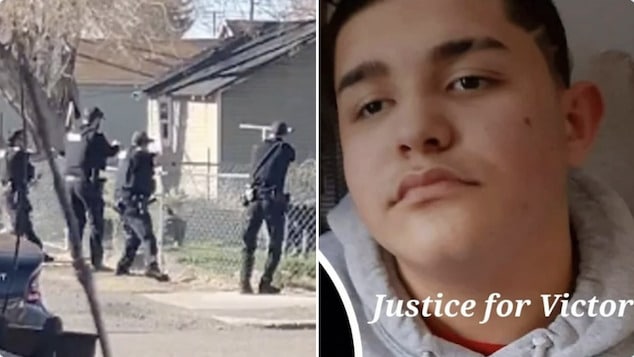

Idaho cops who shot Pocatello autistic teen Victor Perez dead not to face charges as officers acted with what information they knew at the time amid ongoing questions regarding excessive ‘justified’ police force.
Was 12 gunshots at a distance at 12 feet against autistic teen excessive use of police force? Could the situation or ought to it have been handled another way. Is default response the use of violence standard police training?
Idaho prosecutors on Wednesday announced that they will not seek criminal charges against four Pocatello police officers who fatally shot a nonverbal teenager with autism, while responding to a call in April.
‘The death of 17-year-old Victor Perez was a tragedy,’ Deputy Attorney General Jeff Nye wrote in a letter outlining the outcome on Wednesday, CBS News reported.

Pocatello officers default response to 911 call
‘The State would be unable to prove beyond a reasonable doubt that the four officers who discharged their weapons were not justified in using deadly force. We will thus not file criminal charges against the officers,’ he added.
The Eastern Idaho Critical Incident Task Force investigated the shooting. Prosecutors said they focused on what the officers reasonably knew at the time.
‘The officers’ knowledge was limited to what dispatch reported, and dispatch’s knowledge was limited to what the 911 caller reported. Neither the 911 caller, dispatch, nor the officers were aware of Perez’s age or his disabilities. Instead, the officers were told they were heading into a disturbance where an intoxicated male was trying to stab others with a knife,’ the letter states.
Officers were called to Perez’s home on April 5 by a neighbor, who saw the teen holding a knife amid an altercation with members of his family in their backyard. When officers arrived, they moved to a 4-foot chain-link fence around the backyard. Perez, who also had cerebral palsy, had fallen over and was on the ground when officers arrived.
Pocatello, ID🥔
•Victor Perez shot & injured by police•
⚠️Protests erupt⚠️Irrelevant factors⬇️
•Autistic
•Nonverbal
•17 y.o.Relevant factors⬇️
•Armed w/ a 🔪
•Behind a fenceMy take:
•Deadly force is reasonable once he clears the fence.
••Not before. pic.twitter.com/ErLKaH8Qvb— police.law.news (@policelawnews) April 9, 2025
An immediate threat of death or serious bodily injury?
Guns drawn, they repeatedly yelled, ‘Drop the knife!’ only for the intellectually disabled teen to stand up and began to step toward them. Three officers opened fire with their handguns, while a fourth fired a bean-bag shotgun. A total of 12 gunshots struck the nonverbal teen.
Nye wrote in the letter Wednesday that, ‘it would have been better for everyone had the officers kept their distance from the fence.’ But he said the officers acted on the information they had at the time.
Investigators later estimated the distance between the officers and Perez at about 12 feet. Perez died at a hospital six days later after being taken off life support.
Perez was nonverbal and had developmental delays, autism, aggressive behavior, abnormal gait and other medical conditions, according to his autopsy, the East Idaho News reported.
‘His family tried to keep him away from knives for his protection and the protection of those around him. But on April 5, 2025, he managed to gain access to a large kitchen knife with an approximately 9-inch blade,’ Nye wrote.
A use-of-force expert hired by the state found that ‘any reasonable officer’ in the same position, with the same limited information, would have seen the person with the knife as ‘an immediate threat of death or serious bodily injury’ when the shooting began, the letter from the Idaho Attorney General’s Office states.
The letter also noted that Idaho law ‘does not require officers to use less lethal options or to retreat when deadly force is justified.’ It also does not require police to try a Taser or other less-lethal tools before using deadly force.
In the letter, Nye acknowledged the public outrage the case garnered. He wrote that the situation is ‘tragic and heart-rending,’ and that if officers had known more at the time, ‘our conclusions might be different.’ While stressing that prosecutors are obligated to to base their decisions ‘only on what the officers actually knew or reasonably believed at the time,’ and on the law.
Officers from the Pocatello Police Department had responded to Perez’s home in the past, but none of them were present at the time of the shooting. Nye said AG investigators learned during the follow-up investigation that the Pocatello Police Department does not flag residences for mental health issues.
James Cook, an attorney for the Perez family, said they were ‘disappointed’ but not ‘surprised.’ He added that the family will file an amended complaint in their wrongful death lawsuit using information from the state’s materials.
Related posts:


